Included with subscription
A subscription unlocks every workbook. Preview chapters are always free.
Subscribe for full accessSign in to start previewFirst 6 lessons free. Adds to your library so you can pick up later.
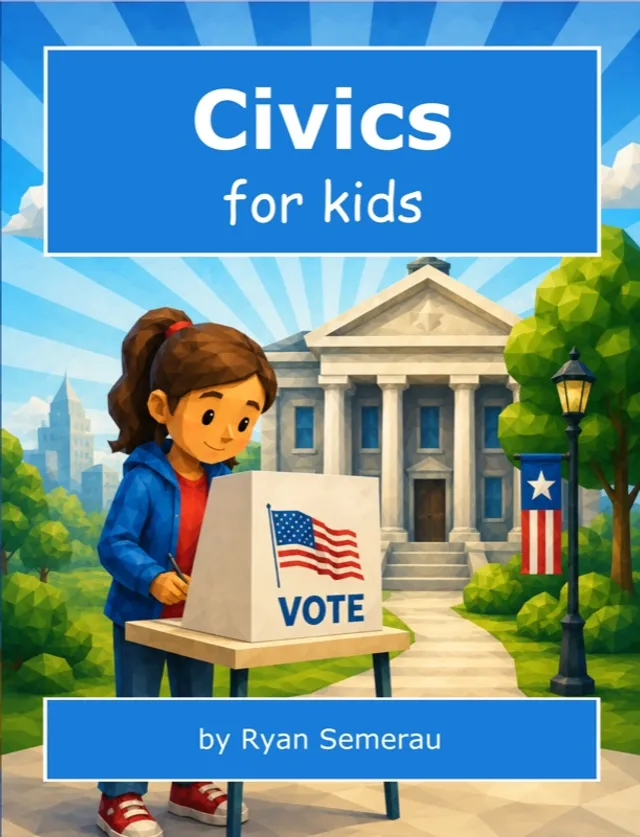
Civics for Kids
by Ryan Semerau
A standalone book that teaches how self-governance works in practice - from local government to federal, elections to taxes, citizen participation to civic virtues. Politically neutral and focused on how the system works, not which side is right.
Contents
16 chapters · 76 lessons · first 6 free- IntroductionFree
1 · Foundations of Civics
- 1.1 · What Does "Civics" Mean?Free
- 1.2 · What Is Citizenship?Free
- 1.3 · Self-GovernanceFree
- 1.4 · Why Civics Matters for YouFree
- Chapter 1 TestFree
2 · Local Government
- 2.1 · Government Closest to HomeFree
- 2.2 · Mayors and City Councils🔒
- 2.3 · School Boards🔒
- 2.4 · How Local Government Affects You🔒
- Chapter 2 Test🔒
3 · County and State Government
- 3.1 · Counties🔒
- 3.2 · State Legislatures🔒
- 3.3 · Governors🔒
- 3.4 · What States Do🔒
- Chapter 3 Test🔒
4 · The Federal Government in Practice
- 4.1 · Congress in Action🔒
- 4.2 · The President's Role Beyond Signing Laws🔒
- 4.3 · Federal Agencies🔒
- 4.4 · How the Levels Connect🔒
- Chapter 4 Test🔒
5 · How Laws Are Really Made
- 5.1 · An Idea Becomes a Bill🔒
- 5.2 · Committees: Where the Work Happens🔒
- 5.3 · Debate, Amendment, and Voting🔒
- 5.4 · Why It's Slow and Why That's the Design🔒
- Chapter 5 Test🔒
6 · Elections and Voting
- 6.1 · How Elections Work🔒
- 6.2 · Primaries and General Elections🔒
- 6.3 · The Electoral College🔒
- 6.4 · Why Voting Matters🔒
- Chapter 6 Test🔒
7 · Political Parties and the Political Process
- 7.1 · What Is a Political Party?🔒
- 7.2 · The Two Major Parties🔒
- 7.3 · Third Parties and Independents🔒
- 7.4 · Partisanship and Compromise🔒
- Chapter 7 Test🔒
8 · Taxes and Public Services
- 8.1 · What Are Taxes?🔒
- 8.2 · What Taxes Pay For🔒
- 8.3 · Budgets: Where the Money Goes🔒
- 8.4 · The Debate Over Taxes🔒
- Chapter 8 Test🔒
9 · How Citizens Participate
- 9.1 · Voting Is Just the Start🔒
- 9.2 · Contacting Your Representatives🔒
- 9.3 · Public Meetings and Public Comment🔒
- 9.4 · Civic Organizations and Running for Office🔒
- Chapter 9 Test🔒
10 · Rights and Responsibilities
- 10.1 · Rights Come with Responsibilities🔒
- 10.2 · The Responsibility to Be Informed🔒
- 10.3 · Jury Duty🔒
- 10.4 · Civic Duty and the Common Good🔒
- Chapter 10 Test🔒
11 · The Media and Informed Citizenship
- 11.1 · The Role of a Free Press🔒
- 11.2 · News vs. Opinion🔒
- 11.3 · Evaluating Sources🔒
- 11.4 · Media Literacy🔒
- Chapter 11 Test🔒
12 · Protest, Petition, and Civil Disobedience
- 12.1 · The Right to Assemble and Petition🔒
- 12.2 · Peaceful Protest🔒
- 12.3 · Civil Disobedience🔒
- 12.4 · How Change Happens🔒
- Chapter 12 Test🔒
13 · Immigration and Citizenship
- 13.1 · Who Is a Citizen?🔒
- 13.2 · Immigration: Coming to a New Country🔒
- 13.3 · Naturalization: Becoming a Citizen🔒
- 13.4 · Immigration as a Civic Topic🔒
- Chapter 13 Test🔒
14 · Civic Virtues
- 14.1 · What Are Civic Virtues?🔒
- 14.2 · Tolerance and Respect🔒
- 14.3 · Compromise and Honesty🔒
- 14.4 · Civic Courage🔒
- Chapter 14 Test🔒
15 · You and Your Government
- 15.1 · How It All Fits Together🔒
- 15.2 · Your Role🔒
- 15.3 · Self-Governance Is an Ongoing Project🔒
- 15.4 · What You Know Now🔒
- Chapter 15 Test🔒
What you'll learn
- ✓What civics is and why self-governance matters
- ✓How local government works and why it matters most to your daily life
- ✓How county, state, and federal government each play different roles
- ✓How laws are really made in practice - from idea to signed law
- ✓How elections work - primaries, general elections, and the Electoral College
- ✓What political parties are and how the political process works
- ✓What taxes are and what they pay for at every level of government
- ✓How citizens participate beyond just voting
- ✓The balance between rights and responsibilities
- ✓How to evaluate the media and be an informed citizen
- ✓How protest, petition, and civil disobedience drive change
- ✓How immigration and citizenship work
- ✓What civic virtues are and why they sustain democracy
How to use this workbook
15 chapters, designed for one chapter per week (4 short lessons per week plus a chapter test). Each lesson takes about 15-20 minutes - read the lesson, talk it over with the AI tutor, then answer a few short questions in your own words.
Prerequisites
None. This book stands alone. Pairs well with Law for Kids and the Constitution book, but doesn't depend on them.