Included with subscription
A subscription unlocks every workbook. Preview chapters are always free.
Subscribe for full accessSign in to start previewFirst 6 lessons free. Adds to your library so you can pick up later.
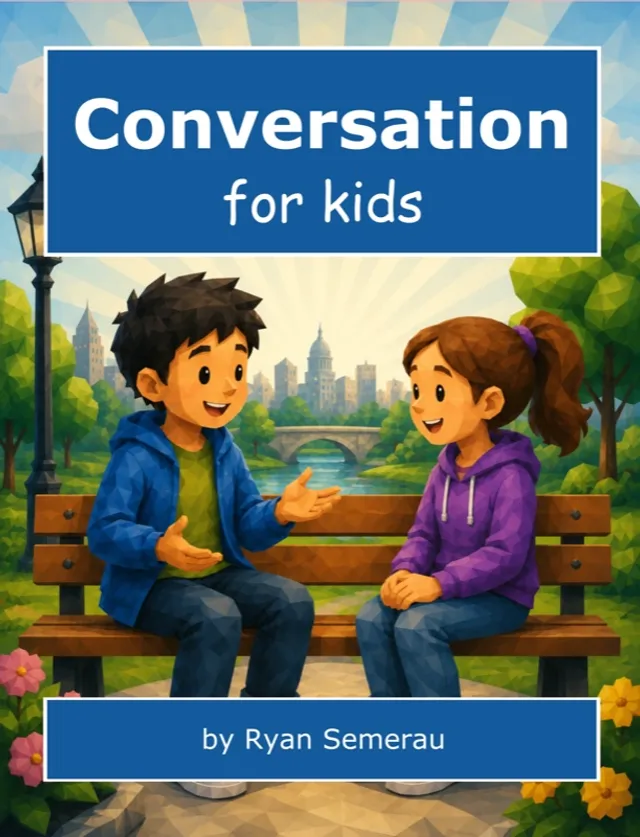
Conversation for Kids
by Ryan Semerau
A practical guide to conversation for young readers. Teaches the mechanics of talking with people - starting conversations, listening, asking questions, reading body language, handling disagreements, and navigating difficult situations. Conversation treated as a learnable skill, not a personality trait.
Contents
16 chapters · 76 lessons · first 6 free- IntroductionFree
1 · The Basics
- 1.1 · More Than Taking TurnsFree
- 1.2 · A Skill Not a TalentFree
- 1.3 · Why Conversation MattersFree
- 1.4 · The Two-Way StreetFree
- Chapter 1 TestFree
2 · Starting a Conversation
- 2.1 · The First MoveFree
- 2.2 · Openers That Work🔒
- 2.3 · Reading Whether Someone Is Open🔒
- 2.4 · The First 30 Seconds🔒
- Chapter 2 Test🔒
3 · Listening
- 3.1 · The Most Important Skill🔒
- 3.2 · Active Listening🔒
- 3.3 · Showing You're Listening🔒
- 3.4 · Remembering What People Say🔒
- Chapter 3 Test🔒
4 · Asking Good Questions
- 4.1 · Open vs Closed Questions🔒
- 4.2 · Follow-Up Questions🔒
- 4.3 · Genuine Curiosity🔒
- 4.4 · The Question Balance🔒
- Chapter 4 Test🔒
5 · Being Interesting
- 5.1 · Having Something to Say🔒
- 5.2 · Telling Good Stories🔒
- 5.3 · Sharing Opinions🔒
- 5.4 · The Balance Between Asking and Telling🔒
- Chapter 5 Test🔒
6 · Reading People
- 6.1 · Body Language Basics🔒
- 6.2 · Facial Expressions and Tone🔒
- 6.3 · Signs of Interest vs Boredom🔒
- 6.4 · Adjusting🔒
- Chapter 6 Test🔒
7 · Manners and Courtesy
- 7.1 · Greetings and Introductions🔒
- 7.2 · Please, Thank You, and Basic Courtesy🔒
- 7.3 · Eye Contact and Attention🔒
- 7.4 · Table Manners and Group Settings🔒
- Chapter 7 Test🔒
8 · Small Talk
- 8.1 · Small Talk Is Not Shallow🔒
- 8.2 · Common Topics🔒
- 8.3 · Transitioning to Real Talk🔒
- 8.4 · When Small Talk Is Enough🔒
- Chapter 8 Test🔒
9 · Saying No
- 9.1 · Why Saying No Is Hard🔒
- 9.2 · When to Say No🔒
- 9.3 · How to Say No Clearly and Kindly🔒
- 9.4 · Different Ways to Say No🔒
- Chapter 9 Test🔒
10 · Disagreeing Well
- 10.1 · Disagreement Is Normal🔒
- 10.2 · Attack the Idea, Not the Person🔒
- 10.3 · Staying Calm🔒
- 10.4 · When to Let It Go🔒
- Chapter 10 Test🔒
11 · Difficult Conversations
- 11.1 · Apologizing🔒
- 11.2 · Giving Honest Feedback🔒
- 11.3 · Bringing Up Something Uncomfortable🔒
- 11.4 · Standing Up for Yourself🔒
- Chapter 11 Test🔒
12 · Ending Conversations
- 12.1 · Why Endings Matter🔒
- 12.2 · Reading When It's Time🔒
- 12.3 · Exit Lines That Work🔒
- 12.4 · Leaving People Feeling Good🔒
- Chapter 12 Test🔒
13 · Different People, Different Conversations
- 13.1 · Talking to Adults🔒
- 13.2 · Talking to Younger Kids🔒
- 13.3 · Authority Figures🔒
- 13.4 · People Different from You🔒
- Chapter 13 Test🔒
14 · Digital Conversations
- 14.1 · Texting and Messaging🔒
- 14.2 · Emoji and Tone🔒
- 14.3 · When to Text vs Call vs Talk in Person🔒
- 14.4 · Group Chats and Social Media🔒
- Chapter 14 Test🔒
15 · Getting Better at Conversation
- 15.1 · Practice🔒
- 15.2 · Watching Good Conversationalists🔒
- 15.3 · Recovering from Awkward Moments🔒
- 15.4 · Confidence Comes from Doing🔒
- Chapter 15 Test🔒
What you'll learn
- ✓What conversation actually is and why it matters
- ✓How to start a conversation with anyone
- ✓How to listen so people feel heard
- ✓How to ask questions that lead to interesting answers
- ✓How to read what people are feeling from their words and body language
- ✓How to be polite without being fake
- ✓How to make small talk that isn't boring
- ✓How to say no clearly and kindly
- ✓How to disagree without making enemies
- ✓How to have difficult conversations when something matters
- ✓How to handle digital conversations - texting, video, online
- ✓How to end a conversation gracefully
How to use this workbook
15 chapters, designed for one chapter per week (4 short lessons per week plus a chapter test). Each lesson takes about 15-20 minutes - read the lesson, talk it over with the AI tutor, then answer a few short questions in your own words.
Prerequisites
None. This book stands alone.