Included with subscription
A subscription unlocks every workbook. Preview chapters are always free.
Subscribe for full accessSign in to start previewFirst 6 lessons free. Adds to your library so you can pick up later.
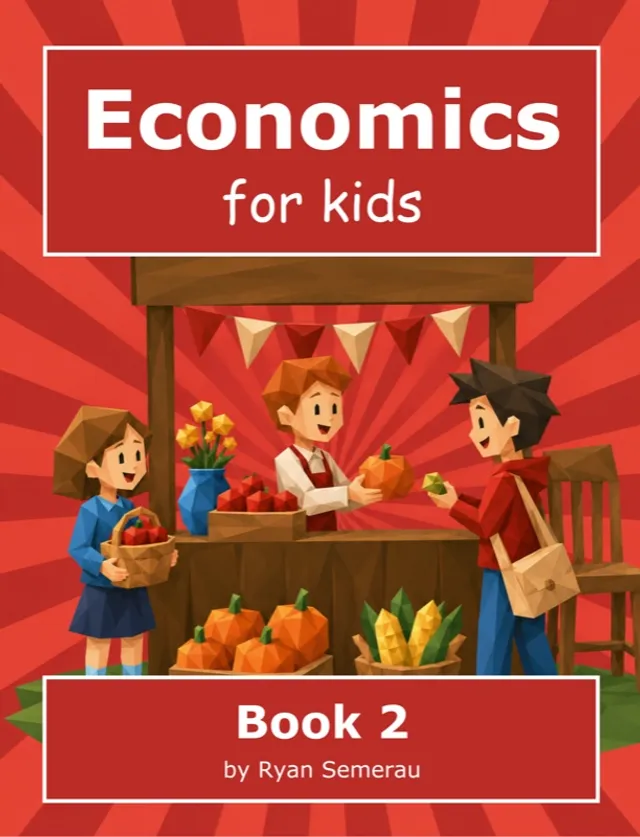
Economics for Kids — Book 2
by Ryan Semerau
The second book in the Economics for Kids series. Explores how people interact through trade, contracts, trust, risk, and cooperation — all in plain language with real-world examples kids can relate to. Covers ownership, insurance, incentives, competition, externalities, and more.
Contents
16 chapters · 76 lessons · first 6 free- IntroductionFree
1 · Ownership, Exchange, and Promises
- 1.1 · OwnershipFree
- 1.2 · Why Ownership MattersFree
- 1.3 · Unclear OwnershipFree
- 1.4 · Sharing and PromisesFree
- Chapter 1 TestFree
2 · Trade and Agreements
- 2.1 · Trade BasicsFree
- 2.2 · Fair Trades🔒
- 2.3 · Agreements🔒
- 2.4 · Agreements and Planning🔒
- Chapter 2 Test🔒
3 · Contracts
- 3.1 · Contracts🔒
- 3.2 · Terms and Conditions🔒
- 3.3 · Broken Contracts🔒
- 3.4 · Kid-Proof Contracts🔒
- Chapter 3 Test🔒
4 · Trust and Information
- 4.1 · Why Trust Matters🔒
- 4.2 · Information for Trade🔒
- 4.3 · Missing Information🔒
- 4.4 · Imperfect Information🔒
- Chapter 4 Test🔒
5 · Uncertainty
- 5.1 · Surprises🔒
- 5.2 · Planning Under Uncertainty🔒
- 5.3 · Choices Under Uncertainty🔒
- 5.4 · Flexibility🔒
- Chapter 5 Test🔒
6 · Risk
- 6.1 · What Risk Is🔒
- 6.2 · Risk vs. Luck🔒
- 6.3 · Safe vs. Risky🔒
- 6.4 · Managing Risk🔒
- Chapter 6 Test🔒
7 · Insurance
- 7.1 · Sharing Risk🔒
- 7.2 · Why Buy Insurance🔒
- 7.3 · How Insurance Works🔒
- 7.4 · What Insurance Covers🔒
- Chapter 7 Test🔒
8 · Moral Hazard
- 8.1 · Protection Changes Choices🔒
- 8.2 · Moral Hazard Examples🔒
- 8.3 · Insurance and Behavior🔒
- 8.4 · Good Protection Design🔒
- Chapter 8 Test🔒
9 · Adverse Selection
- 9.1 · Private Information🔒
- 9.2 · Who Buys Protection🔒
- 9.3 · Group Effects🔒
- 9.4 · Balancing the Pool🔒
- Chapter 9 Test🔒
10 · Marginal Cost
- 10.1 · Kinds of Costs🔒
- 10.2 · One More Cost🔒
- 10.3 · Rising Costs🔒
- 10.4 · Next-Step Decisions🔒
- Chapter 10 Test🔒
11 · Marginal Benefit
- 11.1 · Kinds of Benefits🔒
- 11.2 · One More Benefit🔒
- 11.3 · When to Stop🔒
- 11.4 · Costs and Benefits🔒
- Chapter 11 Test🔒
12 · Sunk Costs
- 12.1 · Sunk Costs🔒
- 12.2 · The Trap🔒
- 12.3 · Better Questions🔒
- 12.4 · Quitting🔒
- Chapter 12 Test🔒
13 · Incentives
- 13.1 · Incentives🔒
- 13.2 · Behavior🔒
- 13.3 · Bad Incentives🔒
- 13.4 · Using Incentives🔒
- Chapter 13 Test🔒
14 · Competition and Monopoly
- 14.1 · Competition🔒
- 14.2 · Barriers to Entry🔒
- 14.3 · Monopoly🔒
- 14.4 · Few Sellers🔒
- Chapter 14 Test🔒
15 · Externalities and Public Goods
- 15.1 · Spillovers🔒
- 15.2 · Externalities🔒
- 15.3 · The Commons🔒
- 15.4 · Public Goods🔒
- Chapter 15 Test🔒
What you'll learn
- ✓What ownership means and why property rights matter
- ✓How trade, agreements, and contracts help people cooperate
- ✓Why trust and information are essential for deals to work
- ✓What uncertainty and risk are, and how insurance helps manage them
- ✓Moral hazard and adverse selection — hidden problems in agreements
- ✓How marginal cost, marginal benefit, and sunk costs shape decisions
- ✓What incentives are and why they drive behavior
- ✓How competition and monopoly affect prices and choices
- ✓What externalities and public goods are and why they matter
How to use this workbook
15 chapters, designed for one chapter per week (4 short lessons per week plus a chapter test). Each lesson takes about 15–20 minutes — read the lesson, talk it over with the AI tutor, then answer a few short questions in your own words. Your work is graded by the tutor and you can retake a chapter as many times as you need.
Prerequisites
Completion of Economics for Kids Book 1, or a basic understanding of scarcity, supply and demand, money, and trade.