Included with subscription
A subscription unlocks every workbook. Preview chapters are always free.
Subscribe for full accessSign in to start previewFirst 6 lessons free. Adds to your library so you can pick up later.
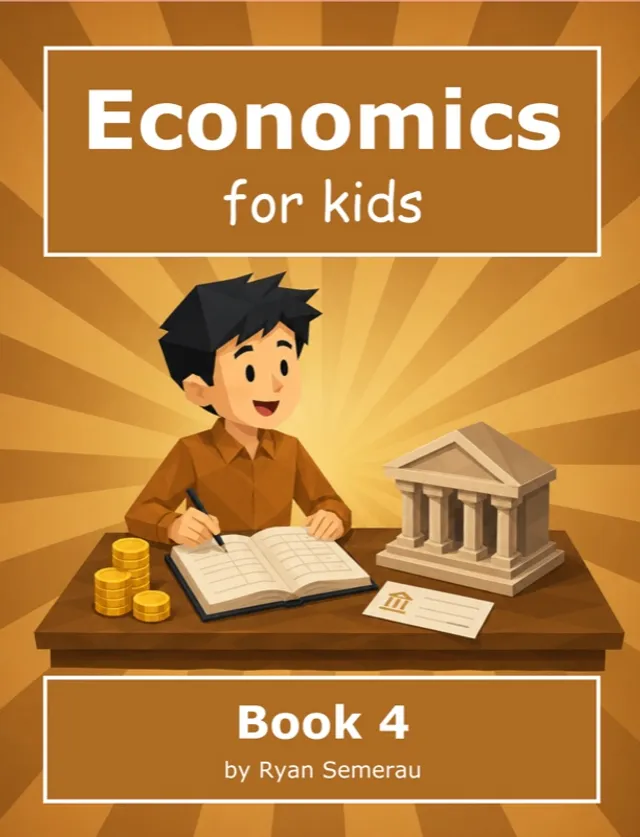
Economics for Kids — Book 4
by Ryan Semerau
The fourth book in the Economics for Kids series. Explains how banks work from the ground up — deposits, loans, reserves, interest rates, the Federal Reserve, bank runs, and financial crises. Makes the banking system understandable for young readers.
Contents
16 chapters · 76 lessons · first 6 free- IntroductionFree
1 · Foundations
- 1.1 · SafekeepingFree
- 1.2 · PaymentsFree
- 1.3 · LendingFree
- 1.4 · TrustFree
- Chapter 1 TestFree
2 · Metal Money and Debasement
- 2.1 · Why Gold and SilverFree
- 2.2 · Coinage🔒
- 2.3 · Debasement🔒
- 2.4 · What Money Is Really About🔒
- Chapter 2 Test🔒
3 · Bank Balance Sheets
- 3.1 · A Bank Is a Stack of Promises🔒
- 3.2 · Assets🔒
- 3.3 · Liabilities and Capital🔒
- 3.4 · Balance and Timing🔒
- Chapter 3 Test🔒
4 · Deposits
- 4.1 · The Deposit Promise🔒
- 4.2 · Checking Accounts🔒
- 4.3 · Savings Accounts and Interest🔒
- 4.4 · Time Deposits and CDs🔒
- Chapter 4 Test🔒
5 · Payments and Settlement
- 5.1 · A Payment Is a Message🔒
- 5.2 · Different Ways to Pay🔒
- 5.3 · Pending, Holds, and Risk🔒
- 5.4 · Why Settlement Matters🔒
- Chapter 5 Test🔒
6 · Reserves and the Central Bank
- 6.1 · What Reserves Are🔒
- 6.2 · The Central Bank🔒
- 6.3 · Settlement With Reserves🔒
- 6.4 · Lender of Last Resort🔒
- Chapter 6 Test🔒
7 · Fractional Reserve Banking
- 7.1 · Fractional Reserves🔒
- 7.2 · How Loans Create Deposits🔒
- 7.3 · What Limits Lending🔒
- 7.4 · What People Get Wrong🔒
- Chapter 7 Test🔒
8 · Lending Standards
- 8.1 · Underwriting🔒
- 8.2 · Creditworthiness🔒
- 8.3 · Collateral and Secured Loans🔒
- 8.4 · Tightening and Loosening Standards🔒
- Chapter 8 Test🔒
9 · Bank Interest Rates
- 9.1 · Interest as a Price🔒
- 9.2 · Deposit Rates🔒
- 9.3 · Loan Rates and Risk🔒
- 9.4 · The Spread🔒
- Chapter 9 Test🔒
10 · Liquidity vs. Solvency
- 10.1 · Liquidity🔒
- 10.2 · Solvency🔒
- 10.3 · Why People Confuse Them🔒
- 10.4 · The Policy Problem🔒
- Chapter 10 Test🔒
11 · Maturity Transformation
- 11.1 · Maturity🔒
- 11.2 · The Timing Mismatch🔒
- 11.3 · Interest Rates and Maturity🔒
- 11.4 · Why Banks Do It Anyway🔒
- Chapter 11 Test🔒
12 · Bank Runs
- 12.1 · A Run Is About Timing🔒
- 12.2 · Information and Rumors🔒
- 12.3 · Deposit Insurance🔒
- 12.4 · Central Banks in a Panic🔒
- Chapter 12 Test🔒
13 · Fiat Money and the Fed
- 13.1 · Fiat Money🔒
- 13.2 · What the Fed Is🔒
- 13.3 · Money Supply and Bank Lending🔒
- 13.4 · Inflation and Credibility🔒
- Chapter 13 Test🔒
14 · Regulation and Deposit Insurance
- 14.1 · Why Banks Have Rules🔒
- 14.2 · Capital Requirements🔒
- 14.3 · Liquidity Rules and Stress Tests🔒
- 14.4 · Deposit Insurance Revisited🔒
- Chapter 14 Test🔒
15 · Shadow Banking and Crises
- 15.1 · What Shadow Banking Is🔒
- 15.2 · Runs Outside Banks🔒
- 15.3 · How Crises Spread🔒
- 15.4 · Lessons From Crises🔒
- Chapter 15 Test🔒
What you'll learn
- ✓Why banks exist and what they actually do
- ✓How metal money worked and what debasement means
- ✓What bank balance sheets, deposits, and payments are
- ✓How reserves, the central bank, and fractional reserve banking work
- ✓What lending standards and interest rates mean for borrowers
- ✓The difference between liquidity and solvency
- ✓What maturity transformation is and why it creates fragility
- ✓How bank runs happen and what stops them
- ✓What fiat money, the Fed, deposit insurance, and regulation do
- ✓What shadow banking is and how financial crises unfold
How to use this workbook
15 chapters, designed for one chapter per week (4 short lessons per week plus a chapter test). Each lesson takes about 15–20 minutes — read the lesson, talk it over with the AI tutor, then answer a few short questions in your own words. Your work is graded by the tutor and you can retake a chapter as many times as you need.
Prerequisites
Completion of Economics for Kids Books 1–3, or a solid understanding of basic economics, personal finance, and how money works.