Included with subscription
A subscription unlocks every workbook. Preview chapters are always free.
Subscribe for full accessSign in to start previewFirst 6 lessons free. Adds to your library so you can pick up later.
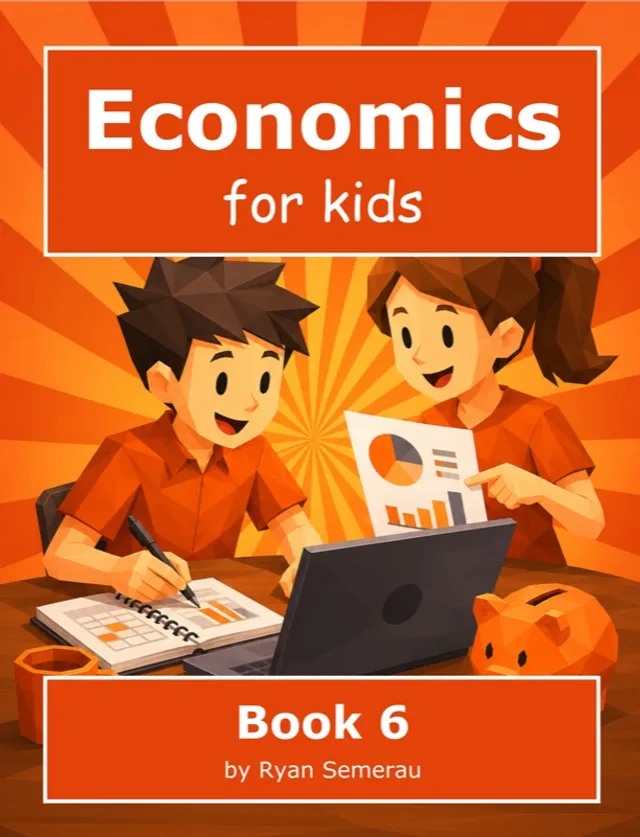
Economics for Kids — Book 6
by Ryan Semerau
The sixth book in the Economics for Kids series. Goes inside a business to explain financial statements, profit vs. cash, cost structure, pricing, investment decisions, time value of money, equity, debt, and corporate governance. Business finance made accessible for young readers.
Contents
16 chapters · 76 lessons · first 6 free- IntroductionFree
1 · Understanding a Business
- 1.1 · Firms and CustomersFree
- 1.2 · Inputs and OutputsFree
- 1.3 · Make or BuyFree
- 1.4 · What Firms Aim ForFree
- Chapter 1 TestFree
2 · The Three Financial Statements
- 2.1 · The Income StatementFree
- 2.2 · The Balance Sheet🔒
- 2.3 · The Cash Flow Statement🔒
- 2.4 · How the Statements Connect🔒
- Chapter 2 Test🔒
3 · Profit vs. Cash
- 3.1 · Two Different Stories🔒
- 3.2 · Getting Paid Later🔒
- 3.3 · Inventory and Growth🔒
- 3.4 · Managing Cash🔒
- Chapter 3 Test🔒
4 · Working Capital
- 4.1 · What Working Capital Is🔒
- 4.2 · Receivables, Inventory, Payables🔒
- 4.3 · The Cash Conversion Cycle🔒
- 4.4 · Funding the Gap🔒
- Chapter 4 Test🔒
5 · Cost Structure
- 5.1 · Fixed and Variable Costs🔒
- 5.2 · Scale and Average Cost🔒
- 5.3 · Break-Even Thinking🔒
- 5.4 · Operating Leverage🔒
- Chapter 5 Test🔒
6 · Marginal Decisions in Business
- 6.1 · Marginal Cost and Marginal Benefit🔒
- 6.2 · Marginal Revenue and Pricing🔒
- 6.3 · Sunk Costs and Opportunity Cost🔒
- 6.4 · Capacity and Hiring🔒
- Chapter 6 Test🔒
7 · Pricing and Unit Economics
- 7.1 · Unit Economics🔒
- 7.2 · Unit Cost🔒
- 7.3 · Pricing Strategies🔒
- 7.4 · CAC and LTV🔒
- Chapter 7 Test🔒
8 · Investment Projects
- 8.1 · What an Investment Project Is🔒
- 8.2 · Forecasting Cash Flows🔒
- 8.3 · Comparing Costs and Benefits Over Time🔒
- 8.4 · Avoiding Project Mistakes🔒
- Chapter 8 Test🔒
9 · Time Value of Money
- 9.1 · Why Time Matters🔒
- 9.2 · Interest and Compounding🔒
- 9.3 · Discounting as a Translation🔒
- 9.4 · Payback and Simple Rules🔒
- Chapter 9 Test🔒
10 · Risk and Return for Projects
- 10.1 · Uncertainty and Scenarios🔒
- 10.2 · Risk and Return🔒
- 10.3 · Diversification🔒
- 10.4 · Hurdle Rates🔒
- Chapter 10 Test🔒
11 · Financing with Equity
- 11.1 · What Equity Means🔒
- 11.2 · Shares and Dilution🔒
- 11.3 · Valuation Basics🔒
- 11.4 · Equity Investors🔒
- Chapter 11 Test🔒
12 · Debt Financing and Bankruptcy
- 12.1 · What Debt Is🔒
- 12.2 · Loan Terms and Covenants🔒
- 12.3 · Leverage🔒
- 12.4 · Bankruptcy🔒
- Chapter 12 Test🔒
13 · Capital Structure
- 13.1 · Debt vs. Equity🔒
- 13.2 · Why Debt Can Be Cheaper🔒
- 13.3 · Target Capital Structure🔒
- 13.4 · Financial Distress🔒
- Chapter 13 Test🔒
14 · Payouts vs. Reinvestment
- 14.1 · What Profits Are For🔒
- 14.2 · Dividends and Buybacks🔒
- 14.3 · Reinvestment and Growth🔒
- 14.4 · Buffers and Resilience🔒
- Chapter 14 Test🔒
15 · Governance and Incentives
- 15.1 · Ownership and Control🔒
- 15.2 · Boards and Oversight🔒
- 15.3 · Incentives and Moral Hazard🔒
- 15.4 · Trust and Reputation🔒
- Chapter 15 Test🔒
What you'll learn
- ✓What a firm is and how businesses are organized
- ✓How to read the three financial statements (income, balance sheet, cash flow)
- ✓The difference between profit and cash
- ✓What working capital is and why it matters
- ✓How businesses think about costs, pricing, and unit economics
- ✓How to evaluate whether an investment project is worth doing
- ✓What the time value of money means
- ✓How companies raise money through equity and debt
- ✓What bankruptcy means and how it works
- ✓How capital structure, payouts, and governance shape business decisions
How to use this workbook
15 chapters, designed for one chapter per week (4 short lessons per week plus a chapter test). Each lesson takes about 15–20 minutes — read the lesson, talk it over with the AI tutor, then answer a few short questions in your own words. Your work is graded by the tutor and you can retake a chapter as many times as you need.
Prerequisites
Completion of Economics for Kids Books 1–5, or a solid understanding of economics, personal finance, banking, and macroeconomics.