Included with subscription
A subscription unlocks every workbook. Preview chapters are always free.
Subscribe for full accessSign in to start previewFirst 6 lessons free. Adds to your library so you can pick up later.
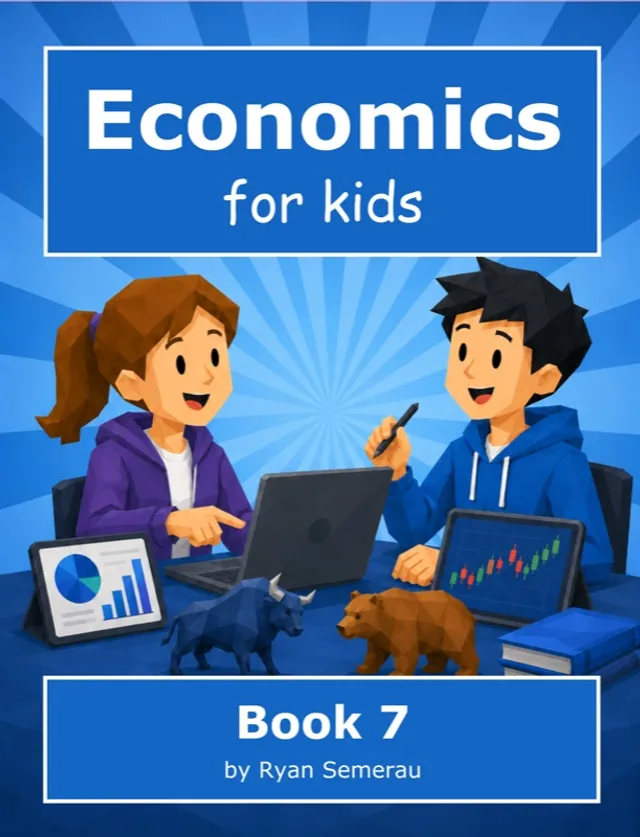
Economics for Kids — Book 7
by Ryan Semerau
The seventh book in the Economics for Kids series. Covers investing and financial markets — stocks, bonds, risk, diversification, index funds, ETFs, trading, options, futures, and cross-border investing. Demystifies the financial markets for young readers.
Contents
16 chapters · 76 lessons · first 6 free- IntroductionFree
1 · Markets and Stocks
- 1.1 · What a Financial Market IsFree
- 1.2 · Raising MoneyFree
- 1.3 · Buying and Selling LaterFree
- 1.4 · Prices, Rules, and TrustFree
- Chapter 1 TestFree
2 · Stocks as Ownership Claims
- 2.1 · A Share of a CompanyFree
- 2.2 · Dividends and Reinvestment🔒
- 2.3 · Voting and Control🔒
- 2.4 · Being Paid Last🔒
- Chapter 2 Test🔒
3 · Why Stock Prices Move
- 3.1 · The Market Price🔒
- 3.2 · Profits, Growth, and Surprises🔒
- 3.3 · Time and Interest Rates🔒
- 3.4 · Risk and Noise🔒
- Chapter 3 Test🔒
4 · Bonds as Debt Claims
- 4.1 · What a Bond Is🔒
- 4.2 · Coupons and Payments🔒
- 4.3 · Bonds vs. Stocks🔒
- 4.4 · Why Borrow With Bonds🔒
- Chapter 4 Test🔒
5 · Bond Prices and Rates
- 5.1 · The Bond Price🔒
- 5.2 · Yield and the Opposite Direction🔒
- 5.3 · Interest Rate Risk🔒
- 5.4 · Premium and Discount Bonds🔒
- Chapter 5 Test🔒
6 · Credit Risk and Spreads
- 6.1 · Credit Risk🔒
- 6.2 · Credit Ratings🔒
- 6.3 · Spreads🔒
- 6.4 · Default and Recovery🔒
- Chapter 6 Test🔒
7 · Risk Premia
- 7.1 · Risk and Reward🔒
- 7.2 · The Risk Premium🔒
- 7.3 · Different Kinds of Risk🔒
- 7.4 · Risk Appetite and Fear🔒
- Chapter 7 Test🔒
8 · Diversification and Portfolios
- 8.1 · What Diversification Means🔒
- 8.2 · Building a Portfolio🔒
- 8.3 · Rebalancing🔒
- 8.4 · Diversifying Across Asset Types🔒
- Chapter 8 Test🔒
9 · Index Funds vs. Active
- 9.1 · Passive and Active🔒
- 9.2 · Why Beating the Market Is Hard🔒
- 9.3 · Fees, Taxes, and Compounding🔒
- 9.4 · When Active Can Make Sense🔒
- Chapter 9 Test🔒
10 · Mutual Funds and ETFs
- 10.1 · What a Fund Is🔒
- 10.2 · Mutual Funds🔒
- 10.3 · ETFs🔒
- 10.4 · Choosing Between Them🔒
- Chapter 10 Test🔒
11 · Trading and Market Makers
- 11.1 · What Trading Is🔒
- 11.2 · Market Makers🔒
- 11.3 · Orders: Market and Limit🔒
- 11.4 · Liquidity and Spreads🔒
- Chapter 11 Test🔒
12 · Auctions and Order Books
- 12.1 · The Order Book🔒
- 12.2 · How Auctions Set Prices🔒
- 12.3 · Continuous Trading🔒
- 12.4 · Fragility and Price Jumps🔒
- Chapter 12 Test🔒
13 · Options
- 13.1 · What an Option Is🔒
- 13.2 · Why People Use Options🔒
- 13.3 · What Makes an Option Valuable🔒
- 13.4 · Moneyness and Risk🔒
- Chapter 13 Test🔒
14 · Futures and Commodities
- 14.1 · What a Future Is🔒
- 14.2 · Hedging With Futures🔒
- 14.3 · Speculators and Liquidity🔒
- 14.4 · Commodity Prices and Real Life🔒
- Chapter 14 Test🔒
15 · FX and Cross-Border Investing
- 15.1 · What an Exchange Rate Is🔒
- 15.2 · Why Exchange Rates Move🔒
- 15.3 · Currency Risk for Investors🔒
- 15.4 · Other Cross-Border Risks🔒
- Chapter 15 Test🔒
What you'll learn
- ✓What financial markets do and why they exist
- ✓What stocks are and how they represent ownership
- ✓Why stock prices move up and down
- ✓What bonds are and how they differ from stocks
- ✓How bond prices relate to interest rates and credit risk
- ✓What risk premia are and why riskier investments pay more
- ✓Why diversification matters and how portfolios work
- ✓The difference between index funds, mutual funds, and ETFs
- ✓How trading works, including market makers and order books
- ✓What options, futures, and foreign exchange are
How to use this workbook
15 chapters, designed for one chapter per week (4 short lessons per week plus a chapter test). Each lesson takes about 15–20 minutes — read the lesson, talk it over with the AI tutor, then answer a few short questions in your own words. Your work is graded by the tutor and you can retake a chapter as many times as you need.
Prerequisites
Completion of Economics for Kids Books 1–6, or a strong understanding of economics, personal finance, banking, macroeconomics, and business finance.