Included with subscription
A subscription unlocks every workbook. Preview chapters are always free.
Subscribe for full accessSign in to start previewFirst 6 lessons free. Adds to your library so you can pick up later.
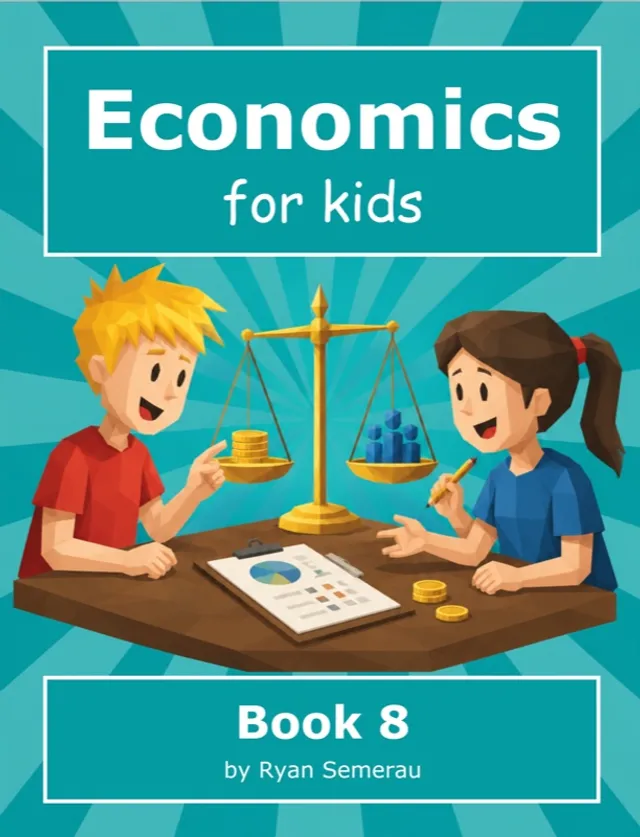
Economics for Kids — Book 8
by Ryan Semerau
The eighth and final book in the Economics for Kids series. Covers the analytical tools economists use — surplus, elasticity, game theory, market power, antitrust, labor markets, price controls, taxes, and fiscal vs. monetary policy. The capstone of the series.
Contents
16 chapters · 75 lessons · first 6 free- IntroductionFree
1 · Tools for Thinking
- 1.1 · Consumer SurplusFree
- 1.2 · Producer SurplusFree
- 1.3 · Total SurplusFree
- Chapter 1 TestFree
2 · Elasticity and Incidence
- 2.1 · What Elasticity MeansFree
- 2.2 · Price Elasticity of DemandFree
- 2.3 · Tax Incidence🔒
- 2.4 · Pass-Through and Side Effects🔒
- Chapter 2 Test🔒
3 · Correlation and Causation
- 3.1 · What Correlation Is🔒
- 3.2 · Confounders and Hidden Causes🔒
- 3.3 · Experiments and Natural Experiments🔒
- 3.4 · Measuring and Being Honest🔒
- Chapter 3 Test🔒
4 · Game Theory
- 4.1 · What Game Theory Is🔒
- 4.2 · The Prisoner’s Dilemma🔒
- 4.3 · Coordination and Expectations🔒
- 4.4 · Credible Threats and Promises🔒
- Chapter 4 Test🔒
5 · Collusion
- 5.1 · What Collusion Is🔒
- 5.2 · The Temptation to Cheat🔒
- 5.3 · Cartels and Price Wars🔒
- 5.4 · Detecting Collusion🔒
- Chapter 5 Test🔒
6 · Monopoly and Antitrust
- 6.1 · What a Monopoly Is🔒
- 6.2 · Barriers to Entry🔒
- 6.3 · Pricing Power and Tradeoffs🔒
- 6.4 · Antitrust Basics🔒
- Chapter 6 Test🔒
7 · Platforms and Network Effects
- 7.1 · What a Platform Is🔒
- 7.2 · Network Effects🔒
- 7.3 · Switching Costs and Lock-In🔒
- 7.4 · Pricing in Multi-Sided Markets🔒
- Chapter 7 Test🔒
8 · Price Discrimination
- 8.1 · What Price Discrimination Is🔒
- 8.2 · Versions and Self-Selection🔒
- 8.3 · Resale and Arbitrage🔒
- 8.4 · Who Wins and Who Loses🔒
- Chapter 8 Test🔒
9 · Monopsony
- 9.1 · What a Monopsony Is🔒
- 9.2 · Wages and Buyer Power🔒
- 9.3 · Reducing Monopsony Power🔒
- 9.4 · Buyer Power Beyond Labor🔒
- Chapter 9 Test🔒
10 · Labor Markets
- 10.1 · Jobs and Wages🔒
- 10.2 · Human Capital🔒
- 10.3 · The Job Package🔒
- 10.4 · Matching Workers to Jobs🔒
- Chapter 10 Test🔒
11 · Search and Bargaining
- 11.1 · Job Search🔒
- 11.2 · Bargaining and Outside Options🔒
- 11.3 · Contracts and Incentives🔒
- 11.4 · Collective Bargaining🔒
- Chapter 11 Test🔒
12 · Minimum Wage
- 12.1 · What a Minimum Wage Is🔒
- 12.2 · Competitive vs Monopsony Markets🔒
- 12.3 · How Employers Respond🔒
- 12.4 · Enforcement and Tradeoffs🔒
- Chapter 12 Test🔒
13 · Price Controls
- 13.1 · Price Ceilings🔒
- 13.2 · Rent Control🔒
- 13.3 · Price Floors🔒
- 13.4 · Shortages, Surpluses, and Workarounds🔒
- Chapter 13 Test🔒
14 · Taxes and Public Choice
- 14.1 · Why Governments Tax🔒
- 14.2 · Tax Incidence Revisited🔒
- 14.3 · Efficient Taxes and Distortions🔒
- 14.4 · Public Choice🔒
- Chapter 14 Test🔒
15 · Fiscal vs. Monetary Policy
- 15.1 · Fiscal Policy🔒
- 15.2 · Monetary Policy🔒
- 15.3 · Comparing the Tools🔒
- 15.4 · Uncertainty and Credibility🔒
- Chapter 15 Test🔒
What you'll learn
- ✓What surplus and efficiency mean and why they matter
- ✓How elasticity determines who bears the cost of a tax or price change
- ✓The difference between correlation and causation
- ✓How game theory helps explain strategic decisions
- ✓What collusion, monopoly, and antitrust are
- ✓How platforms and network effects create market power
- ✓What price discrimination and monopsony mean
- ✓How labor markets, search, and bargaining work
- ✓What minimum wage and price controls do to markets
- ✓How taxes, public choice, and fiscal vs. monetary policy shape the economy
How to use this workbook
15 chapters, designed for one chapter per week (4 short lessons per week plus a chapter test). Each lesson takes about 15–20 minutes — read the lesson, talk it over with the AI tutor, then answer a few short questions in your own words. Your work is graded by the tutor and you can retake a chapter as many times as you need.
Prerequisites
Completion of Economics for Kids Books 1–7, or a strong understanding of micro and macroeconomics, personal finance, banking, business finance, and investing.