Included with subscription
A subscription unlocks every workbook. Preview chapters are always free.
Subscribe for full accessSign in to start previewFirst 6 lessons free. Adds to your library so you can pick up later.
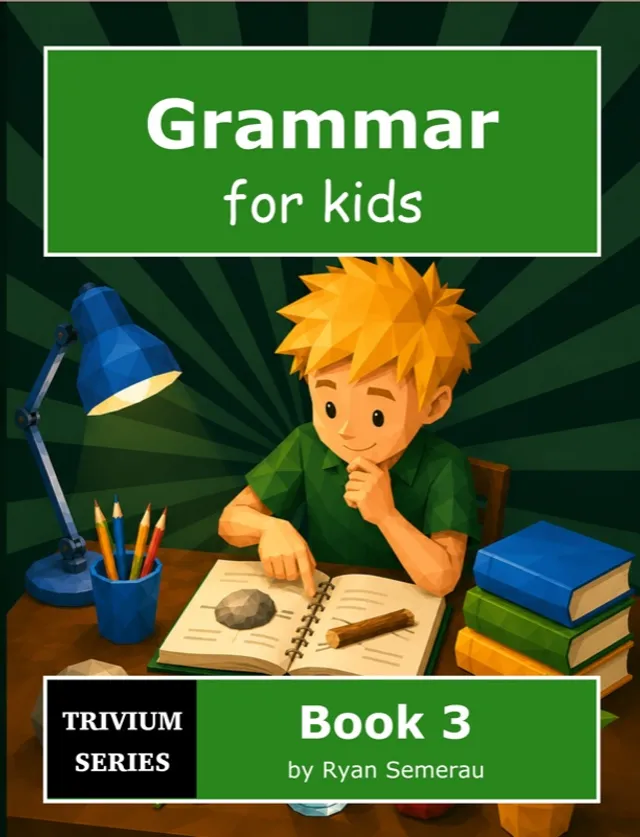
Grammar for Kids - Book 3
by Ryan Semerau
The third and final book in the Grammar for Kids series. Builds on Book 1 (terms) and Book 2 (relationships) to teach how meaning is assembled into complete propositions. Covers the structure of propositions, tense, aspect, mood, agreement, compound and subordinate structures, definiteness, information structure, reported speech, speech acts, presupposition, implication, translation, universality, and the connection from Grammar to Logic in the Trivium.
Contents
16 chapters · 76 lessons · first 6 free- IntroductionFree
1 · Propositions
- 1.1 · From Relationships to StatementsFree
- 1.2 · What Is a PropositionFree
- 1.3 · Sentences vs PropositionsFree
- 1.4 · Simple and Compound PropositionsFree
- Chapter 1 TestFree
2 · The Structure of Simple Propositions
- 2.1 · Subject-Copula-PredicateFree
- 2.2 · Quality: Affirmative and Negative🔒
- 2.3 · Quantity: Universal and Particular🔒
- 2.4 · The Four Types: A, E, I, O🔒
- Chapter 2 Test🔒
3 · Tense - Locating Propositions in Time
- 3.1 · What Tense Does🔒
- 3.2 · How English Handles Tense🔒
- 3.3 · How Other Languages Handle Tense🔒
- 3.4 · Languages Without Tense🔒
- Chapter 3 Test🔒
4 · Aspect - Completion and Duration
- 4.1 · Tense vs Aspect🔒
- 4.2 · Perfective and Imperfective🔒
- 4.3 · Habitual and Progressive🔒
- 4.4 · Aspect Across Languages🔒
- Chapter 4 Test🔒
5 · Mood - The Speaker's Attitude
- 5.1 · What Is Mood🔒
- 5.2 · Indicative: Stating Facts🔒
- 5.3 · Subjunctive: Wishes, Doubts, Hypotheticals🔒
- 5.4 · Imperative, Conditional, and Beyond🔒
- Chapter 5 Test🔒
6 · Agreement - Terms Matching Each Other
- 6.1 · What Is Agreement🔒
- 6.2 · Number Agreement🔒
- 6.3 · Gender Agreement🔒
- 6.4 · Person Agreement🔒
- Chapter 6 Test🔒
7 · Compound Propositions - Connecting Claims
- 7.1 · Joining with "And" (Conjunction)🔒
- 7.2 · Joining with "Or" (Disjunction)🔒
- 7.3 · "If...Then" Propositions (Conditional)🔒
- 7.4 · "If and Only If" (Biconditional)🔒
- Chapter 7 Test🔒
8 · Subordinate Propositions
- 8.1 · Propositions Inside Propositions🔒
- 8.2 · Relative Clauses: Modifying Terms🔒
- 8.3 · Noun Clauses: Propositions as Terms🔒
- 8.4 · Adverbial Clauses: Propositions as Modifiers🔒
- Chapter 8 Test🔒
9 · Definiteness and Reference
- 9.1 · Definite: A Specific Thing🔒
- 9.2 · Indefinite: Any Member of a Kind🔒
- 9.3 · Generic: The Whole Kind🔒
- 9.4 · Demonstratives and Deixis🔒
- Chapter 9 Test🔒
10 · Information Structure
- 10.1 · Topic: What You Are Talking About🔒
- 10.2 · Given and New Information🔒
- 10.3 · Focus: The Important Part🔒
- 10.4 · Word Order as an Information Tool🔒
- Chapter 10 Test🔒
11 · Reported Speech and Evidentiality
- 11.1 · Direct and Indirect Speech🔒
- 11.2 · Why Reported Speech Matters🔒
- 11.3 · Evidentiality: How Do You Know?🔒
- 11.4 · Source and Reliability🔒
- Chapter 11 Test🔒
12 · Performatives and Speech Acts
- 12.1 · Language That Does Things🔒
- 12.2 · Types of Speech Acts🔒
- 12.3 · Indirect Speech Acts🔒
- 12.4 · Conditions for Speech Acts🔒
- Chapter 12 Test🔒
13 · Presupposition and Implication
- 13.1 · Presupposition: What's Taken for Granted🔒
- 13.2 · Types of Presupposition🔒
- 13.3 · Implication: What's Suggested Without Saying🔒
- 13.4 · Pragmatic Inference🔒
- Chapter 13 Test🔒
14 · Translation and Universality
- 14.1 · What Translation Preserves🔒
- 14.2 · What Translation Loses🔒
- 14.3 · Untranslatable Concepts🔒
- 14.4 · Universal Grammar🔒
- Chapter 14 Test🔒
15 · Grammar as the Foundation of Thought
- 15.1 · What You've Learned Across Three Books🔒
- 15.2 · Grammar Is the Structure of Meaning🔒
- 15.3 · From Grammar to Logic🔒
- 15.4 · From Logic to Rhetoric🔒
- Chapter 15 Test🔒
What you'll learn
- ✓What a proposition is and how it differs from a sentence
- ✓The structure of simple propositions - subject, copula, predicate
- ✓The four types of propositions (A, E, I, O)
- ✓How tense locates propositions in time across languages
- ✓How aspect describes the shape of an action - complete, ongoing, habitual
- ✓How mood expresses the speaker's attitude - fact, wish, command, hypothesis
- ✓How agreement makes terms match in number, gender, and person
- ✓How compound propositions connect claims with and, or, if-then
- ✓How subordinate propositions nest meaning inside meaning
- ✓How definiteness and reference work across languages
- ✓How information structure organizes topic, focus, and given vs. new
- ✓How reported speech and evidentiality track the source of claims
- ✓How speech acts use language to do things, not just describe them
- ✓How presupposition and implication carry meaning between the lines
- ✓What translation preserves and what it loses
- ✓How Grammar connects to Logic and the rest of the Trivium
How to use this workbook
15 chapters, designed for one chapter per week (4 short lessons per week plus a chapter test). Each lesson takes about 15-20 minutes - read the lesson, talk it over with the AI tutor, then answer a few short questions in your own words.
Prerequisites
Grammar for Kids Book 1 and Book 2. You should understand what terms are, how they refer to things, how they are defined, and how terms relate to each other before starting this book.