Included with subscription
A subscription unlocks every workbook. Preview chapters are always free.
Subscribe for full accessSign in to start previewFirst 6 lessons free. Adds to your library so you can pick up later.
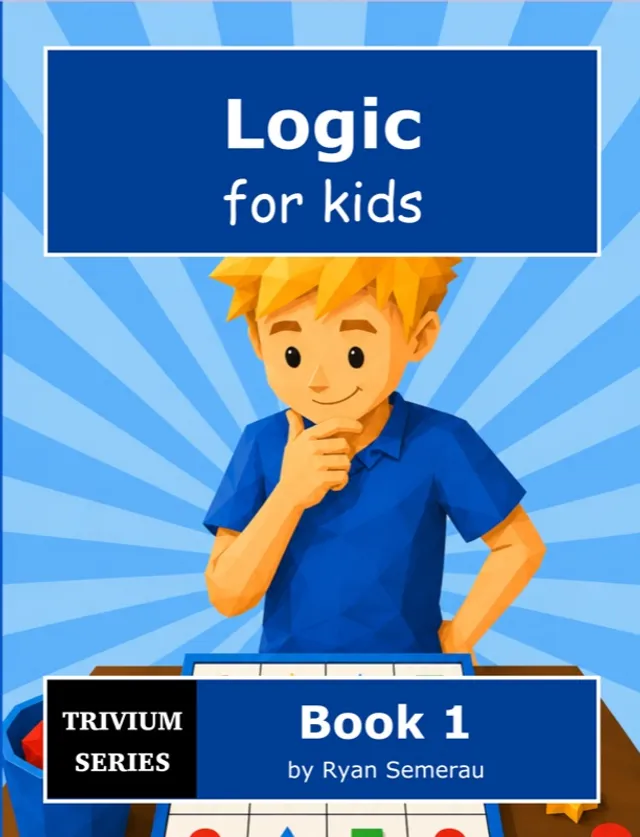
Logic for Kids - Book 1
by Ryan Semerau
The first book in the Logic for Kids series. Covers the foundation of correct reasoning - propositions, distribution, the square of opposition, conversion, obversion, and contraposition. Teaches students to identify, analyze, and draw inferences from categorical propositions using the tools of Aristotelian logic.
Contents
16 chapters · 76 lessons · first 6 free- IntroductionFree
1 · Foundations
- 1.1 · What Is LogicFree
- 1.2 · Truth vs ValidityFree
- 1.3 · Why Logic MattersFree
- 1.4 · The Three Acts of the MindFree
- Chapter 1 TestFree
2 · Terms in Logic
- 2.1 · Terms as Building Blocks of ReasoningFree
- 2.2 · Categorematic and Syncategorematic Terms🔒
- 2.3 · Distribution: A Key Concept🔒
- 2.4 · Why Distribution Matters🔒
- Chapter 2 Test🔒
3 · The Four Categorical Propositions
- 3.1 · Standard Form🔒
- 3.2 · The A Proposition: Universal Affirmative🔒
- 3.3 · The E Proposition: Universal Negative🔒
- 3.4 · The I and O Propositions🔒
- Chapter 3 Test🔒
4 · Distribution in Detail
- 4.1 · The Distribution Pattern🔒
- 4.2 · Why A Distributes Only the Subject🔒
- 4.3 · Why E Distributes Both🔒
- 4.4 · Why O Distributes Only the Predicate🔒
- Chapter 4 Test🔒
5 · The Square of Opposition
- 5.1 · What Is the Square of Opposition🔒
- 5.2 · Contradictories: A vs O, E vs I🔒
- 5.3 · Contraries: A vs E🔒
- 5.4 · Subcontraries and Subalternation🔒
- Chapter 5 Test🔒
6 · Using the Square of Opposition
- 6.1 · Drawing Inferences🔒
- 6.2 · Starting from Each Corner🔒
- 6.3 · Practice with Real Propositions🔒
- 6.4 · Existential Import🔒
- Chapter 6 Test🔒
7 · Conversion
- 7.1 · What Is Conversion🔒
- 7.2 · Simple Conversion: E and I🔒
- 7.3 · Conversion Per Accidens: A🔒
- 7.4 · O Does Not Convert🔒
- Chapter 7 Test🔒
8 · Obversion
- 8.1 · What Is Obversion🔒
- 8.2 · The Complement🔒
- 8.3 · Obversion of All Four Types🔒
- 8.4 · Practice with Real Propositions🔒
- Chapter 8 Test🔒
9 · Contraposition
- 9.1 · What Is Contraposition🔒
- 9.2 · Contraposition of A and O🔒
- 9.3 · E and I Do Not Contrapose🔒
- 9.4 · The Full Picture🔒
- Chapter 9 Test🔒
10 · Combining Immediate Inferences
- 10.1 · Chaining Inferences Together🔒
- 10.2 · All the Equivalences for A🔒
- 10.3 · All the Equivalences for E🔒
- 10.4 · Practice: Deriving Everything You Can🔒
- Chapter 10 Test🔒
11 · Euler Diagrams
- 11.1 · What Are Euler Diagrams🔒
- 11.2 · Diagramming Each Proposition Type🔒
- 11.3 · Using Diagrams to Test Inferences🔒
- 11.4 · Limits of Diagrams🔒
- Chapter 11 Test🔒
12 · Propositions in Ordinary Language
- 12.1 · Everyday Language Is Messy🔒
- 12.2 · Hidden Quantifiers🔒
- 12.3 · "Only" and "None But"🔒
- 12.4 · Exclusive, Exceptive, and Other Tricky Forms🔒
- Chapter 12 Test🔒
13 · Logical Relationships Between Propositions
- 13.1 · Equivalence🔒
- 13.2 · Consistency and Inconsistency🔒
- 13.3 · Independence🔒
- 13.4 · Testing Relationships🔒
- Chapter 13 Test🔒
14 · Complex Propositions in Logic
- 14.1 · Compound Propositions Revisited🔒
- 14.2 · The Conditional Proposition🔒
- 14.3 · Negating Compound Propositions🔒
- 14.4 · Building Toward the Syllogism🔒
- Chapter 14 Test🔒
15 · Review and Preparation
- 15.1 · The Toolkit So Far🔒
- 15.2 · What You Can Do Now🔒
- 15.3 · From One Proposition to Two: The Syllogism🔒
- 15.4 · The Importance of What You Have Learned🔒
- Chapter 15 Test🔒
What you'll learn
- ✓What logic is and how it builds on Grammar
- ✓The difference between truth and validity
- ✓The three acts of the mind
- ✓Categorematic and syncategorematic terms
- ✓What distribution is and why it matters
- ✓The four categorical propositions (A, E, I, O)
- ✓The square of opposition and all its relationships
- ✓Conversion, obversion, and contraposition
- ✓How to chain immediate inferences together
- ✓How to translate ordinary language into standard logical form
How to use this workbook
15 chapters, designed for one chapter per week (4 short lessons per week plus a chapter test). Each lesson takes about 15-20 minutes - read the lesson, talk it over with the AI tutor, then answer a few short questions in your own words.
Prerequisites
Grammar for Kids Books 1-3 strongly recommended. Students should understand what terms, propositions, subjects, predicates, and the A/E/I/O proposition types are.