Included with subscription
A subscription unlocks every workbook. Preview chapters are always free.
Subscribe for full accessSign in to start previewFirst 6 lessons free. Adds to your library so you can pick up later.
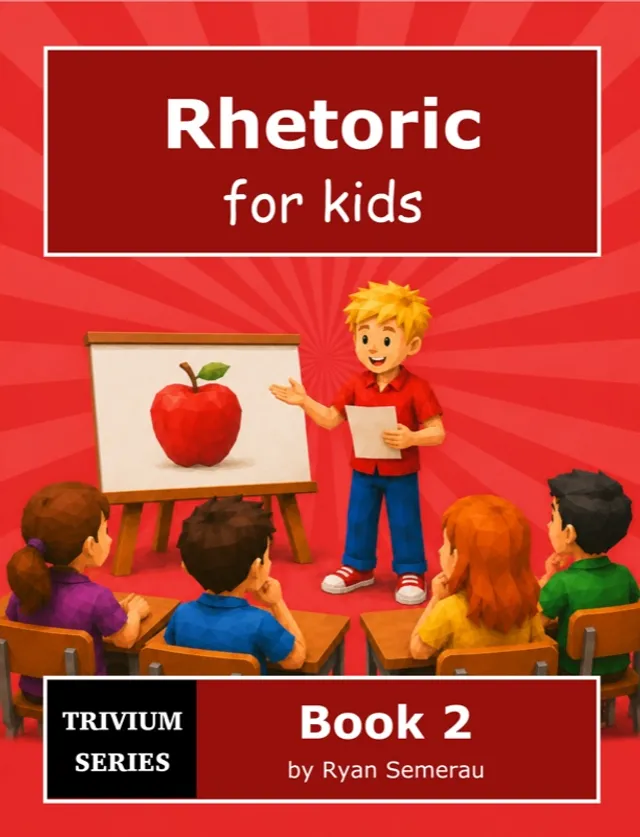
Rhetoric for Kids - Book 2
by Ryan Semerau
The second book in the Rhetoric for Kids series. Teaches how to build complete arguments, refute counterarguments, analyze rhetoric in speeches and media, apply rhetoric in writing and speaking, and understand the ethics of persuasion. Completes the Trivium sequence of Grammar, Logic, and Rhetoric.
Contents
16 chapters · 76 lessons · first 6 free- IntroductionFree
1 · Building Arguments
- 1.1 · Starting with a PositionFree
- 1.2 · Invention: What's Your CaseFree
- 1.3 · Arrangement: What OrderFree
- 1.4 · Integrating the Three AppealsFree
- Chapter 1 TestFree
2 · Constructing Proof
- 2.1 · Lines of ArgumentFree
- 2.2 · Types of Evidence🔒
- 2.3 · From Premises to Conclusion🔒
- 2.4 · Depth vs Breadth🔒
- Chapter 2 Test🔒
3 · Refutation
- 3.1 · Why Refutation Matters🔒
- 3.2 · Types of Refutation🔒
- 3.3 · Steel-Manning🔒
- 3.4 · When and Where to Refute🔒
- Chapter 3 Test🔒
4 · Concession
- 4.1 · What Concession Is🔒
- 4.2 · Why Concession Is Powerful🔒
- 4.3 · Concession + Pivot🔒
- 4.4 · What Not to Concede🔒
- Chapter 4 Test🔒
5 · Written Rhetoric
- 5.1 · Rhetoric on the Page🔒
- 5.2 · The Essay🔒
- 5.3 · Paragraphs as Units of Thought🔒
- 5.4 · Revision: The Writer's Delivery🔒
- Chapter 5 Test🔒
6 · Spoken Rhetoric
- 6.1 · Rhetoric Out Loud🔒
- 6.2 · Speeches🔒
- 6.3 · Debates and Disagreements🔒
- 6.4 · Everyday Conversation🔒
- Chapter 6 Test🔒
7 · Analyzing Rhetoric - Speeches
- 7.1 · How to Analyze a Speech🔒
- 7.2 · Identifying the Three Appeals🔒
- 7.3 · Evaluating the Reasoning🔒
- 7.4 · Learning from Great Speeches🔒
- Chapter 7 Test🔒
8 · Analyzing Rhetoric - Media and Advertising
- 8.1 · Rhetoric in the News🔒
- 8.2 · Rhetoric in Advertising🔒
- 8.3 · Rhetoric in Social Media🔒
- 8.4 · Visual Rhetoric🔒
- Chapter 8 Test🔒
9 · Analyzing Rhetoric - Everyday Arguments
- 9.1 · Rhetoric Between People🔒
- 9.2 · Analyzing Conversations🔒
- 9.3 · Persuading Fairly🔒
- 9.4 · When Persuasion Fails🔒
- Chapter 9 Test🔒
10 · The Ethics of Rhetoric
- 10.1 · Power and Responsibility🔒
- 10.2 · Truth as the Foundation🔒
- 10.3 · Recognizing Misuse🔒
- 10.4 · Integrity🔒
- Chapter 10 Test🔒
11 · Rhetoric and the Other Arts
- 11.1 · Rhetoric and Grammar🔒
- 11.2 · Rhetoric and Logic🔒
- 11.3 · Rhetoric in Every Subject🔒
- 11.4 · Rhetoric as a Life Skill🔒
- Chapter 11 Test🔒
12 · Becoming a Better Communicator
- 12.1 · Rhetoric Takes Practice🔒
- 12.2 · Listening Is Part of Rhetoric🔒
- 12.3 · Feedback and Improvement🔒
- 12.4 · Finding Your Voice🔒
- Chapter 12 Test🔒
13 · Rhetoric and Citizenship
- 13.1 · Rhetoric and Democracy🔒
- 13.2 · Public Deliberation🔒
- 13.3 · Respectful Disagreement🔒
- 13.4 · Informed Participation🔒
- Chapter 13 Test🔒
14 · Common Rhetorical Situations
- 14.1 · Arguing for a Position🔒
- 14.2 · Responding to Criticism🔒
- 14.3 · Explaining Something Complex🔒
- 14.4 · Making a Proposal🔒
- Chapter 14 Test🔒
15 · The Complete Trivium
- 15.1 · The Three Arts as One🔒
- 15.2 · The Progression🔒
- 15.3 · What You Can Do Now🔒
- 15.4 · The Trivium Is Just the Beginning🔒
- Chapter 15 Test🔒
What you'll learn
- ✓How to build a complete argument from start to finish
- ✓How to construct proof with multiple lines of evidence
- ✓How to refute counterarguments and steel-man opposing positions
- ✓How to use concession to build trust and strengthen your case
- ✓How to apply rhetoric in essays and written communication
- ✓How to deliver spoken rhetoric in speeches, debates, and conversations
- ✓How to analyze rhetoric in famous speeches
- ✓How to spot rhetorical techniques in media and advertising
- ✓How to recognize and resist manipulation in everyday arguments
- ✓The ethics of rhetoric and the speaker's responsibility
- ✓How Grammar, Logic, and Rhetoric form one unified art: the Trivium
How to use this workbook
15 chapters, designed for one chapter per week (4 short lessons per week plus a chapter test). Each lesson takes about 15-20 minutes - read the lesson, talk it over with the AI tutor, then answer a few short questions in your own words.
Prerequisites
Rhetoric for Kids Book 1 (required - this book builds directly on the framework from Book 1). Grammar for Kids Books 1-3 and Logic for Kids Books 1-4 strongly recommended. The complete Trivium sequence is Grammar, Logic, then Rhetoric.