Included with subscription
A subscription unlocks every workbook. Preview chapters are always free.
Subscribe for full accessSign in to start previewFirst 6 lessons free. Adds to your library so you can pick up later.
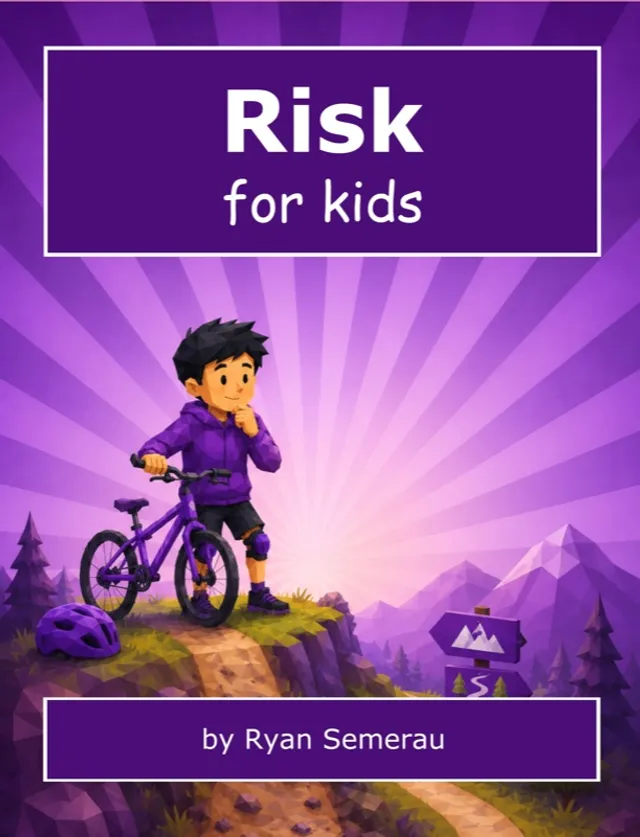
Risk for Kids
by Ryan Semerau
A standalone book that teaches kids how to think about risk and uncertainty. Covers probability, impact, risk matrices, expected value, cognitive biases, risk tradeoffs, and how to make smart decisions when outcomes are uncertain. Clear thinking about risk in plain language for young readers.
Contents
16 chapters · 76 lessons · first 6 free- IntroductionFree
1 · What Risk Is
- 1.1 · Risk Means UncertaintyFree
- 1.2 · Risk Can Be Good or BadFree
- 1.3 · Risk Is EverywhereFree
- 1.4 · Risk vs CertaintyFree
- Chapter 1 TestFree
2 · Likelihood - How Probable Is It?
- 2.1 · What Is ProbabilityFree
- 2.2 · Ways to Express Probability🔒
- 2.3 · Base Rates🔒
- 2.4 · Common vs Rare🔒
- Chapter 2 Test🔒
3 · Impact - How Bad or Good Could It Be?
- 3.1 · What Is Impact🔒
- 3.2 · A Scale of Impact🔒
- 3.3 · Reversibility🔒
- 3.4 · Positive Impact🔒
- Chapter 3 Test🔒
4 · Combining Likelihood and Impact
- 4.1 · The Two Questions🔒
- 4.2 · The Risk Matrix🔒
- 4.3 · Expected Value🔒
- 4.4 · Using the Framework🔒
- Chapter 4 Test🔒
5 · Comparing Risks
- 5.1 · Every Choice Compares Risks🔒
- 5.2 · Comparing Fairly🔒
- 5.3 · The Risk of Doing Nothing🔒
- 5.4 · Comparisons That Surprise People🔒
- Chapter 5 Test🔒
6 · Responding to Risk
- 6.1 · Four Ways to Respond🔒
- 6.2 · Avoid🔒
- 6.3 · Reduce🔒
- 6.4 · Transfer and Accept🔒
- Chapter 6 Test🔒
7 · Risk Tradeoffs
- 7.1 · Safety Has a Cost🔒
- 7.2 · Reducing One Risk Can Create Another🔒
- 7.3 · Acceptable Risk🔒
- 7.4 · Diminishing Returns on Safety🔒
- Chapter 7 Test🔒
8 · Probability and Scale
- 8.1 · Small Numbers Are Tricky🔒
- 8.2 · Orders of Magnitude🔒
- 8.3 · Relative Risk vs Absolute Risk🔒
- 8.4 · Large Populations🔒
- Chapter 8 Test🔒
9 · How Other People Talk About Risk
- 9.1 · Everyone Has a Perspective🔒
- 9.2 · How the News Covers Risk🔒
- 9.3 · Framing: Same Risk, Different Feeling🔒
- 9.4 · Checking Claims🔒
- Chapter 9 Test🔒
10 · Common Mistakes in Risk Thinking
- 10.1 · Judging by What Comes to Mind🔒
- 10.2 · Confusing Familiar with Safe🔒
- 10.3 · Anchoring🔒
- 10.4 · Ignoring Base Rates🔒
- Chapter 10 Test🔒
11 · Risk and Decisions
- 11.1 · Decisions Under Uncertainty🔒
- 11.2 · Using Expected Value🔒
- 11.3 · Sunk Costs🔒
- 11.4 · Reversible vs Irreversible Decisions🔒
- Chapter 11 Test🔒
12 · Types of Risk
- 12.1 · Physical Risk🔒
- 12.2 · Financial Risk🔒
- 12.3 · Social and Reputational Risk🔒
- 12.4 · Health and Information Risk🔒
- Chapter 12 Test🔒
13 · Risk in Groups and Systems
- 13.1 · Shared Risk🔒
- 13.2 · Systemic Risk🔒
- 13.3 · Cascading Failures🔒
- 13.4 · Diversification🔒
- Chapter 13 Test🔒
14 · Risk Over Time
- 14.1 · Risk Changes Over Time🔒
- 14.2 · Monitoring🔒
- 14.3 · Cumulative Risk🔒
- 14.4 · Learning from Outcomes🔒
- Chapter 14 Test🔒
15 · Putting It All Together
- 15.1 · The Risk Framework🔒
- 15.2 · Applying the Framework🔒
- 15.3 · When Others Communicate Risk to You🔒
- 15.4 · Risk as a Life Skill🔒
- Chapter 15 Test🔒
What you'll learn
- ✓What risk really means and why it's not just about danger
- ✓How to estimate the likelihood of something happening
- ✓How to measure impact - both good and bad outcomes
- ✓How to combine likelihood and impact using a risk matrix
- ✓How to compare different risks fairly
- ✓Four ways to respond to any risk: avoid, reduce, transfer, or accept
- ✓Why zero risk is impossible and safety always has a cost
- ✓How to spot common mistakes in risk thinking
- ✓How to evaluate risk claims from news, friends, and advertisers
- ✓A complete framework for making decisions under uncertainty
How to use this workbook
15 chapters, designed for one chapter per week (4 short lessons per week plus a chapter test). Each lesson takes about 15-20 minutes - read the lesson, talk it over with the AI tutor, then answer a few short questions in your own words.
Prerequisites
None. This book stands alone. It pairs well with the Economics for Kids series but does not depend on it.